Globosat Play Platform Restructuring
Globosat Play is a TV Everywhere platform that delivers the Pay TV Channels content from Grupo Globo. This project was focused on guiding this platform restructure with a user-centric approach, big data support, and stakeholders alignment.
Challenge
Due to a technology migration strategy, the platform future vision should be revised considering stakeholder needs and users' new behaviors and needs. The release plan for this new platform should be progressive, existing along with the older version with no damage to the user experience, and focused on increasing KPI.
My roles
Collect qualitative and quantitative user data
Document stakeholders needs
Design respecting technical restrictions
Present platform vision concepts
Define viable Features Roadmap
Follow up visual design and development activities
Globosat Play had been released in 2014, has more than 2,5 MM accounts and receives around 5 MM unique users by month.
When I started working with this product, in 2016, my team had the main goal of solving a technology challenge. It should migrate the entire web platform for React language, to offer a more fluid interaction and build reusable components, so it would be possible to evolve the platform faster and share components with other Grupo Globo video products.
In order to support this big migration as an opportunity to enhance the user experience and also without impact to stakeholders, I performed some activities to understand needs and behavior from both of then.
Some paid TV channels delivered by Globosat Play platform.
Process
Since the platform was a two-year in market product when I arrived at the project, I started performing a "check-up" to understand the product's user scenario, behaviors and needs. Not only during this check-up process, but also during all the project period, I performed some activities to understand user needs and behavior:
Big Data Analysis: I retrieved, manipulated and analyzed data - by myself or with the big data team support - from Google Analytics, Comscore, DAX, Globosat Play executive dashboard and internal Big Data solution;
SAC Information: I read SAC reports and interviewed SAC team in order to identify main pain points from users;
A/B Tests: Although the new platform would consist of a completely new visual design, we run some A/B tests in order to understand user behavior changes according to different interaction offers;

Globosat Play user interview and usability analysis.
Qualitative Research: I designed with the qualitative research team user interviews to (1) understand the user relation with the platform, how it was used, perceived, pain points, future expectations and (2) how is the Brazilian relation with automatic recommendation and personalization features across main content delivery players. Also I conducted guerrilla usability tests with prototypes for some validations.
Furthermore, I performed meetings to map internal players needs (such as editors, product coordinators, etc.) and legacy system restrictions to support the definition of a Vision Proposal focused on Stakeholders alignment, that I explian following.
Vision proposal for Internal Alignments
To ensure alignment across all teams included, I created a shared communication artifact that consolidated both the proposed design changes and the implementation strategy. This initiative brought together stakeholders from multiple areas, including channel representatives, customer support, the teams responsible for maintaining the data consumed by the platform, and the product engineering teams. The material served two main purposes:
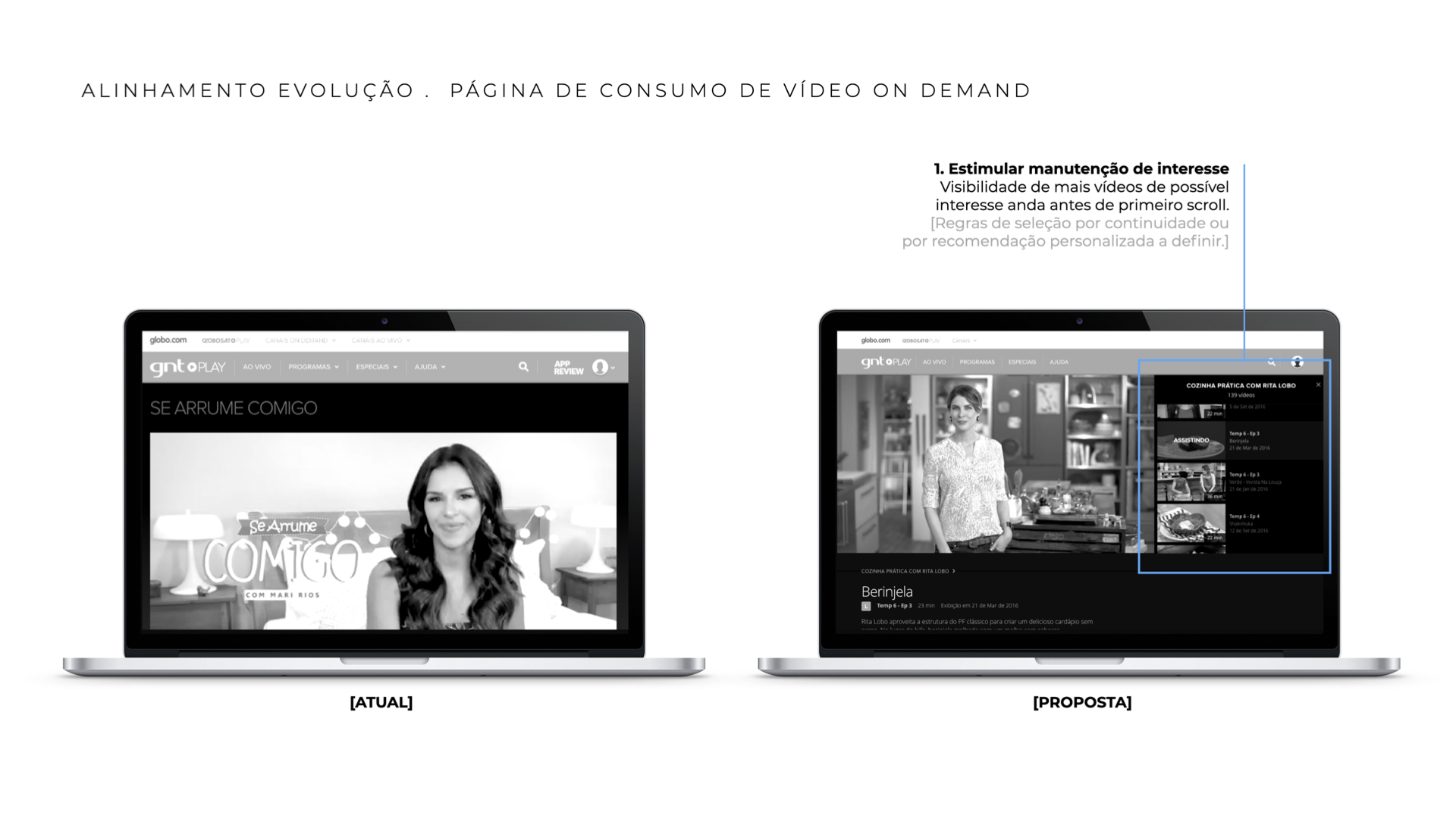
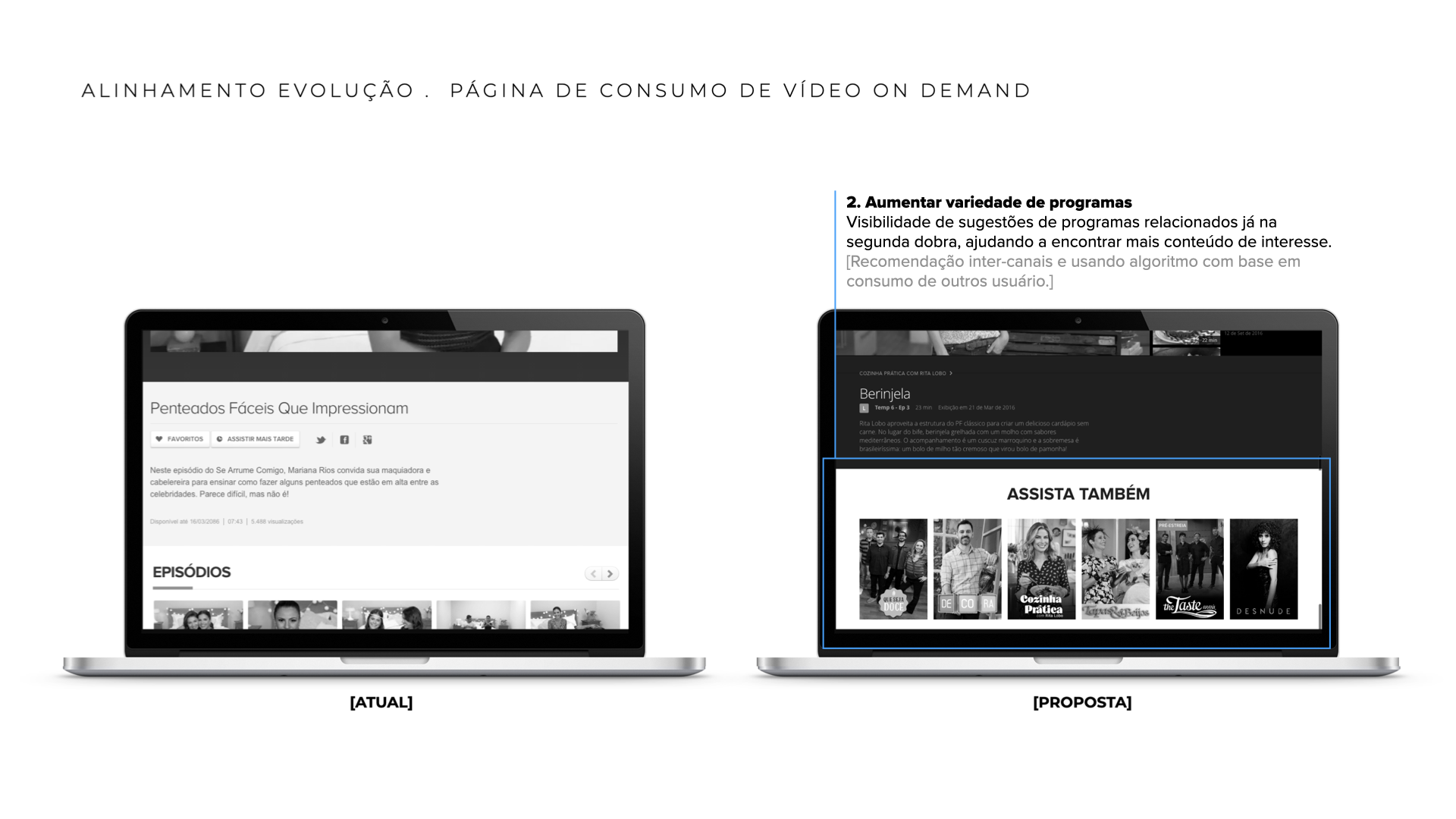
1. Visibility of changes. It provided a low-fidelity concepts of the proposed interface changes, with a particular focus on layout adjustments designed to improve performance and make more efficient use of screen space. It also explained the rationale behind the redesign, outlining why the changes were being introduced at that specific moment, which information should receive greater visibility, and the key user behaviors we wanted to encourage.
2. The rollout plan. Given the scale and complexity of the platform, implementing all changes simultaneously was not feasible. Instead, the rollout was structured into phased milestones rather than fixed dates, allowing stakeholders to understand when each set of changes would be released.

Feature Roadmap focused on providing the first releases that could increase video consumption.
This approach also helped set expectations around temporary inconsistencies during the transition period. The documentation explained why these inconsistencies would be limited in scope and how they would be managed, particularly during milestones where multiple interconnected changes were introduced simultaneously. As a result, all teams had a clear understanding of the implementation sequence and how the overall transition would be coordinated.
Rollout focused on results
The rollout started with the key points of video consumption since it is the heart of the platform and reflects directly at the KPI.
During this rollout development, I have been providing support and helping to validate the deliverables.
The real final result (after the development and public release) of key points of navigation can be seen at this screen recording:
Outputs
As results, we already observed in 2017, compared with 2016, an increase of 28% on video consumption and 36% on new user accounts.
Also, the learning process of using Big Data during the project allowed me to present some cases to the UX community at ISA 2017 and at a Superlogica Labs edition. The keynote and a recording from the presentation are available at the following links.

Photo from my presentation during ISA17
Keynotes from Globosat Play Big Data Cases
Recording from the presentation at Superlógica Labs